
HO 144/10442 and HO 334/111/17525
Michael Alianak was born in Scutari, Constantinople on May 27 or 28, 1870 to Carabed Alianak and Kayane Alianakian, née Beshiktaslian.[1] Since childhood, he was known as Mike or, particularly in his native land, as Michel.[2] He was educated in Constantinople. He arrived in England on April 1, 1886 [sic] at the age of 13 or 14 and left school to work as a junior clerk for his uncle M. Beshiklastian on Dickinson Street, Manchester, where he remained two years. There, he finished his education under a private tutor. Alianak was fluent in English and could speak French and Turkish. His parents died when he was about 14 years of age.
He returned to Constantinople in 1888 and worked there as a merchant for about two years, before making his way back to England in 1891. He stayed in England for about one year before returning again to Constantinople. In 1896, he headed back to England, where he established a permanent home and, with £300 capital, launched a business as a shipping merchant in Manchester, dealing in cotton goods. Alianak had two brothers and a sister living in Constantinople.
Alianak traded on his own account until April 1905, when he was joined by K. Israelian, a merchant based in Constantinople who introduced 900 Turkish pounds (£818 sterling) to the business. The firm traded in Manchester as M. Alianakian & Co., while his partner traded as K. Israelian & Co. Initially, the Manchester firm shipped goods to the East to various customers, but after a time it dealt exclusively with the Constantinople firm. Alianak would invoice the goods to the Constantinople firm at cost price, plus the usual Manchester commission of 2.5 or 3 per cent. The Constantinople firm, in turn, remitted cash to enable the Manchester firm to meet its engagements, and was charged with selling the goods on the other side at a profit. The Constantinople firm gradually got behind with its remittances, and at the end of 1907 owed the Manchester firm £3,872, a sum that included the capital of the Alianak’s company and commission on the invoiced goods. Alianak claimed that he frequently asked his partner for explanations and was repeatedly assured that everything was all right. The growing debt to the Manchester firm, he was told, was due to the necessity the Constantinople firm experienced of having to give long credit.
In February of 1908, Alianak departed for Constantinople to investigate the financial position of his partner. Within nine months, he married Pepron, née Migerdigian (July 9, 1886), a native of Constantinople born to Armenian parents. During his visit, Alianak ascertained that his business partner had been deceiving him. The company they had launched together was bankrupt. Apart from what Israelian owed Alianak, the liabilities of the Constantinople firm amounted to £2,500. The solvency of Alianak’s firm was wholly dependent on its Constantinople counterpart. Alianak assured Home Office officials that his departure for Constantinople did not constitute flight from debt. On the contrary, he argued that his principal creditors in Manchester were fully secured by the cloth they held, and that his journey was in the interest of the creditors, as it offered the possibility of recovering some part of his claim against his Constantinople house. The Home Office, however, was not convinced. Its officials asked Alianak to justify his prolonged stay in Constantinople (he did not return until the beginning of 1911), as well as his failure to authorize the Calico Printers’ Association in Manchester to sell the finished goods in their hands. Alianak explained that during his investigations of his partner in Constantinople, when he discovered government seals on the firm’s warehouse (evidently a sign of receivership), Israelian absconded. Once Alianak informed the Ottoman government of his partnership in the firm, he fell under official surveillance, was apprehended, and was compelled to enter into a bond with sureties not to leave Constantinople until his presence there had been dispensed with by the local bankruptcy officials. Because his Manchester assets did not compensate for the liabilities in the Constantinople bankruptcy, the law did not allow for a “speedy winding-up of the firm’s affairs.” He remained in Constantinople hoping that additional assets would be recovered by Israelian’s return or by some other means.
Ultimately, however, the Ottoman authorities abandoned the idea of making a substantial payment, and in early 1911 they paid a dividend of 10 percent on the claims in Constantinople. At this point, Alianak was released from his bond and returned at once to England. Upon arriving in Manchester in 1911, Alianak commenced business at 40 Cooper Street on his own account. Upon learning that he was back in town, Alianak’s creditors filed a petition that year at the Manchester County Court, suing for the £3,000 he owed them. At this court, Alianak was adjudged bankrupt. His creditors took possession of the cloth he had left at the Calico Printers’ Association. The revenue generated from the sale of this cloth and the confiscation of his office furniture enabled Alianak to obtain his discharge in early 1912.
Alianak further explained to investigators that he had been reluctant to authorize the Calico Printers’ Association to print and sell the cloth, the only remainder of his estate, except at a good price, so he could yield at least a dividend to the unsecured creditors. After holding out for a better price, the printers were forced to sell at a loss in 1909. The official receiver in Manchester who investigated the case concluded that neither the printers nor Alianak were blameworthy. This receiver reasoned that the former had every reason to seek the highest payment for the finished goods, while Alianak “seems to have conducted the business in Manchester with perfect integrity.” The investigator could find no evidence of collusion between Alianak and Israelian to increase the assets of the Constantinople house at the expense of its English creditors. On the other hand, he concluded in January of 1912 that Alianak “may have committed errors of judgment in allowing the Constantinople debit to grow so large and in omitting to authorize the realization of the cloth in the hands of the Calico Printers’ Association.” The Home Office conducted its own inquiries and, despite the favorable report of the receiver, concluded that Alianak left Manchester in 1908 “to evade his creditors.”
Alianak evidently found it impossible to earn his living as a shipper during World War I. He opened a restaurant called the Alexander Café, which he operated for 3 years at 37 Brazennose Street, Manchester (1916-1918). In 1918, he returned to the shipping trade in that city. His wife’s private wealth no doubt helped Alianak stay afloat. Pepron had invested a substantial sum of money in the District Bank Limited, war bonds, and insurance policies.
Alianak applied for naturalization several times unsuccessfully (in 1920, 1926, 1927, and 1929), owing to his frequent sojourns and trips to Constantinople, his bankruptcy, and perhaps also apparent discrepancies in the timeline of his biography (see, for example, paragraph 1 above). He informed the Home Office that since returning to England in 1911, he had undertaken only “short business visits abroad.” His first application, filed in late 1920, seems to have anticipated a business trip to the Ottoman Empire, for which he preferred “to travel on a British passport,” as he deemed he “would be safer naturalized.” Variously, his stated reasons for applying for naturalization were that he planned to “remain in the United Kingdom”, “protect his business and family interest” there, and if necessary, “enter the service of the Crown.” Additionally, he regarded England, where he had resided since 1896, as his home, and had “become attached to English manners and modes of life.” Another motivation was no doubt to rid himself of the liabilities brought on by his enemy alien status, including periodic registration requirements and government surveillance. In 1916, while visiting Blackpool for a few days, Alianak and his wife were fined £1 for neglecting to furnish a hotel keeper with a “required, signed statement” that included their home address in Manchester. Alianak’s postwar trips to Turkey occurred in 1926 and 1929, when he went to Constantinople to interview prospective customers. Having secured a number of orders, he returned to England about three months later. Pepron accompanied her husband to Constantinople in 1929 and stayed with relatives there for over a year, although she had planned to return in December. In March of that year, the couple visited Paris on “a combined pleasure and business trip.” The couple was childless by 1929.
Another roadblock to naturalization was Alianak’s national status. In 1921, Major General Bagratouni, a representative in London of the Armenian republic, issued Alianak a certificate of nationality just after the country’s fleeting existence (1918-1920), but by then erstwhile diplomats of Armenia were no longer recognized internationally. At the request of the Home Office, Alianak obtained another certificate of Armenian nationality, this time signed by the Armenian Bishop of Manchester in 1927. But the Home Office regarded Alianak as a Turkish subject, based partly on his birthplace of Constantinople. Additionally, during World War I, Alianak had listed himself as a “Turk” on his alien registration card and in 1926, he obtained a Turkish passport in Liverpool. Yet, on his 1926 naturalization memorial, Alianak identified himself as “Armenian Ottoman.” The Home Office recognized in 1927 that the Ottoman authorities would “in all probability, place many difficulties in his way if he was travelling on anything other than a Turkish passport.”
Alianak’s fortunes had improved by the late 1920s. He was financially solvent and enjoyed a good reputation in business circles. His partnership with Asadour Mannisian of Constantinople had been successful, but was dissolved by mutual consent at the end of 1928. Alianak immediately launched his own business as a shipping merchant in Manchester, with a capital of £1,004. He placed orders with manufacturers in Manchester and shipped the finished goods to Constantinople. Since 1924, Alianak and Pepron had resided in Blackpool, on the coast of England, northwest of Manchester, whence he commuted daily by train to his warehouse and office.
Alianak’s referees in 1921 were all from Manchester: a plumber, a company house keeper, a manager of a packing company, head porter of the Manchester Athenaeum (where Alianak had been a member for twenty years), a manager of a wood bleaching company, the principal of a colored goods manufacturer, and a solicitor’s managing clerk. For his later applications, Alianak’s referees also included his landlady in Manchester and a butcher. The Home Office disqualified the plumber from serving as referee when they learned that he knew the applicant only slightly and had been offered a reward for his service. According to the Home Office, Alianak did not know many people outside of the Armenian community, so enlisting referees may have been challenging.
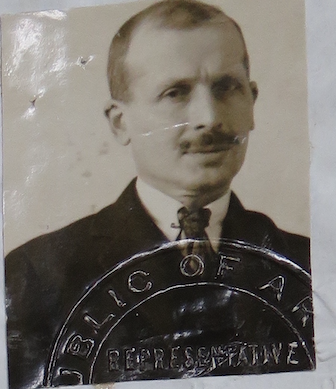
If we judge 1896 to be the year of his permanent settlement, Alianak had lived in England over 20 years by his first application and over 30 years by the time of his last application. He was 59 years old when he was finally naturalized in 1929.
Subfiles 1, 2 and 3 were destroyed. This file was originally closed until 2030 and declassified on February 20, 2014 at my request.
[1] Also pronounced Garabed; also Alianakian; also rendered Aayane. On his naturalization, he lists his parents’ last name as Alianak. However, since he abbreviated his family name only after his bankruptcy, and his parents died when he was 13 or 14, it is likely that he was born with the last name Alianakian, which also appears in his naturalization file as Alianiakian.
[2] On his identity paper, he spelled his first name as Miké.