
HO 405/2474 and HO 334/393/39088
Isaac Behar, also known as Victor Behar and Alfred Salisse, was born in Constantinople on July 14, 1896 to Elya and Rachel Behar, née Levy, both “Turkish” and both deceased by 1955, the year Isaac was finally naturalized.[1] Isaac had two sisters, both of them deceased by 1955, and two brothers, one of them resident in Israel and the other in Paris. He arrived at Folkestone, a coastal town on the English Channel, in Kent (southeast England) on July 14, 1914 and then proceeded to London, where he was employed as a carpet repairer by Samuel Pashaian, a refugee from Sivas who opened the Armenian Carpet Repairing Company on Victoria Avenue in 1916. Behar also worked for the Ottoman Sephardi Jew Franses at 24a Grafton Street. Both men were interviewed as part of Isaac’s first naturalization application in 1933 and vouched for his “good character.” Isaac eventually became a carpet dealer in London.
He duly registered with the Glasgow Police as an alien “of Turkish nationality” just after the outbreak of war in 1914 and again in 1919. During the war, “although of enemy race,” Isaac was not interned. Instead, he was engaged for three months towards the end of 1918 on road making in Northumberland, which was classified as “work of national service.” On his naturalization applications, he indicated that he had lost his Turkish nationality “by reason of my failure to do military service.” Behar noted that he did not serve in the Ottoman Army because he “could not proceed to Turkey owing to the outbreak of war,” inadvertently suggesting that he would have fought in the Ottoman military had the opportunity presented itself.[2] This explanation may have given the Home Office pause.
In late December of 1919, Isaac left London for Glasgow. While single and working as a carpet repairer, he lived at 46 Buccleuch Street.[3] He then obtained employment as a carpet repairer and workshop manager with Messrs. Wolffson & Shenkin, West Regent Street. In March of 1921 he reported to the Aliens Registration Department of the Glasgow Police that he had started business on his own account at 313 Great Western Road as a repairer and dealer of Oriental carpets and art objects. In 1926, he moved his business premises, The Oriental Carpet Art Galleries, to 492 Sauchiehall Street.[4] At that time, he had two employees, a Turkish salesman and a female British carpet repairer.[5]
Behar married a British-born woman named Mildred Dunn, of Russian parentage, on November 2, 1920, at the Western Synagogue in London. By the time of his final application, the couple lived at 105 Gower Street, Glasgow. They had two daughters: Esther Elain, born October 9, 1921, and Pearl, born February 17, 1924. Both were “Turkish” and British born.[6]
The first naturalization application Isaac submitted in 1933 raised warning flags for the Home Office, after officials there asked the Aliens Registration Department of the Glasgow police to investigate his background. Enquiries among wholesale carpet manufacturers and importers in London revealed that Isaac was known at two houses, the Oriental Carpet Manufacturers (O.C.M. Ltd.) at 4 Newgate Street, E.C., and Eastern Carpets Ltd., Newton Street, W.C. The O.C.M. Ltd. informed the police investigator that Behar had done business with them for some years, but they had had considerable difficulty in getting their money and would not grant him further credits. This firm’s Glasgow representative, who happened to be present when the police investigator called, said that he knew Isaac quite well. The representative informed the investigator that “it was common knowledge in the North that Behar travels through Scotland demanding exorbitant prices for his carpets and misrepresenting their value and country of origin. The secretary of Eastern Carpets Ltd. informed the investigator that Behar would buy from them about £500 worth of carpets a year and that he has always met his accounts when due. The Eastern Carpets secretary had “no doubt that Behar and others do travel the countryside imposing their wares on the credulous, and that it is the common practice of peddling carpet dealers to give false descriptions of the value and country of origin of their goods.”[7]
Police investigators who discovered moral or legal deficits in an applicant’s biography seldom regarded ethnicity as relevant. In Isaac’s case, however, the City of Glasgow Police reported to the Home Office in 1933 that they had “received information that Behar is associated with a ring of Jews who travel the country selling Oriental carpets at exorbitant prices and defrauding the purchasers of large sums of money by falsely representing the carpets to be of much greater value than they actually are.” Isaac allegedly participated in this “ring of Jews” under the pseudonym Mr. Sallace.[8] In late 1937, Isaac was charged at the High Court of Judiciary with fraud involving £23,000 in value, relating to his sale of “alleged Oriental carpets.” He was sentenced to three years of penal servitude at Saughton Prison in Edinburgh.
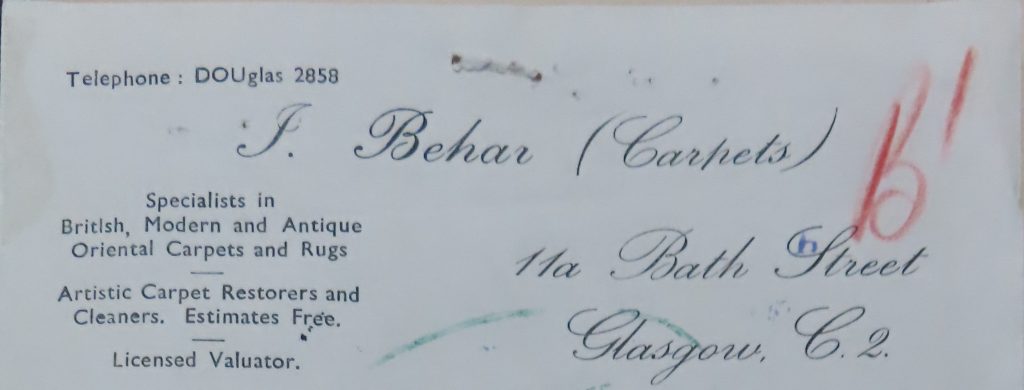
After his release from prison, Isaac remade himself. He recommenced business in March 1940 at 21 Bath Street, Glasgow. In 1945, he partnered with his son-in-law Sydney Slater and daughter Pearl Behar or Slater, co-directors of the firm. Isaac was the main partner in the business, owning 60 percent of the capital, while the Slaters owned 40 percent between them. Home Office officials commented that Isaac’s ill-gotten profits, which he never returned to his clients, allowed him to relaunch himself so quickly and lucratively after release from imprisonment. In May 1947, Isaac relocated his business to 11a Bath Street.[9] By 1948, his letterhead identified his business as “J. Behar (Carpets) 11a Bath Street, Glasgow, C2. Specialists in British, Modern and Antique Oriental Carpets and Rugs. Artistic Carpet Restorers and Cleaners, Estimates Free. Licensed Valuator.”[10] In May 1953, he opened a small store and workshop at 57 Cowcaddens Street and, the following October, took over business premises at 62 Murray Place, Stirling.
On his 1955 naturalization application, Isaac identified himself as stateless because “when he made application for a passport to the Turkish Consul some considerable time ago he was informed that he had been struck off the list of persons of Turkish nationality as he had failed to serve in the Turkish Army during the Great War.”[11]
During his years as an alien in England, Isaac spent holidays in France (seven times total in the period 1924-1926, 1935, 1951 and 1955), Switzerland (1955), Turkey (1954), and Italy (1955). During his visit to Turkey, “he visited and resided with a relative in Istanbul named Maurice Levi to “revisit the country of his birth and renew acquaintanceship with his relatives.”[12] His visit to Switzerland, Italy, and France in May 1955 was “purely for health reasons as he suffers from catarrh.” On his second application, he added that he was in Belgium for “Pleasure and Business” between 1940 and 1946.
Isaac’s written English, barely legible, shows poor spelling and suggestions of a heavy accent. On his dictation test, he wrote: “I Have Ben in this country for a long Time I araived feor a munts Before of of the First World War. Altew I wase then anemi Elia I was not in tairn I have to do Road meking for a piriod I wase Dvieltil [?] in to this work By minisij [i.e. ministry] of laybur. J. Behar. 30th July 1948.” His poor reading and writing skills in English were also discussed in his 1937 trial. Nevertheless, the Procurator Fiscal of Glasgow concluded that Isaac “probably could be regarded as having an adequate knowledge of the English language,” since he wrote and read it poorly but spoke it well.
Behar applied for naturalization in 1927, 1933, 1947, and 1955. After submitting his first application, the Home Office informed him that they would not consider his application until ten years after the conclusion of hostilities. His second application was refused “on suspicion of peddling carpets at exorbitant prices obtained by misrepresenting their value and country of origin.” Additionally, Isaac had been sued for debt “on many occasions between 1921 and 1931” and had a conviction for dangerous driving in 1927. His conviction in 1937 explains why he waited so long to apply for a third and fourth time. The reporting officer in Isaac’s last application concluded that the “applicant has apparently led an honest life and would appear to have rehabilitated himself since his release from prison in 1940. That he is a reformed character is the opinion expressed by his referees all of whom have known him for many years.”
Behar’s referees included the director of a company; a senior partner in an auctioneers firm; the former managing director and chairman of a grain merchant firm, who was also chairman of the Clyde Oil Extraction Co. Ltd.; the manager of a branch of the Commercial Bank of Scotland; the minister emeritus of the Jewish Synagogue in Glasgow; a reverend; a Justice of the Peace and retired bank manager; the managing director of an auctioneers and valuers company on the Glasgow Royal Exchange; two chartered accountants; a medical practitioner who was also the Behar family doctor; a retired foreign merchant; Isaac’s accountant and a fellow member of the synagogue. His naturalization file is a rich source for detecting changing norms in the Oriental carpet trade, the malleable concept of “value” in that trade, and the impact of xenophobia and antisemitism on reformed convicts applying for naturalization.
Isaac Behar was naturalized on October 21, 1955 after over forty years in the United Kingdom. Subfiles 8-12 were destroyed. This file was originally closed until 2056 and was declassified in 2005.
[1] They died in 1916 and 1931, respectively. Isaac’s father’s name is alternatively spelled Liya Behar, perhaps a clerk’s error. Isaac referred to his natal city alternately as “Stamboul” and “Stambull.”
[2] Upon his naturalization in 1955, his registration under the Aliens Order of 1953 was finally canceled and his name removed from the Register of Aliens.
[3] He lived at “46 Buccleuch Street, c/o Martin, Glasgow” from December 3, 1919-September 6, 1920. He lived at 104 Hill Street, Glasgow from September 6, 1920-August 20, 1921; at 280 Bath Street, Glasgow from August 20, 1921-May 24, 1934; at 105 Gower Street, Pollokshields, Glasgow, Lanarkshire, from April 24, 1934 to at least 1955. His 1948 application indicates that he lived at the latter locale from 1940 to 1946.
[4] The name of the establishment was shown above his door, together with his own name. This name is an important reminder that Oriental carpets were not simply merchandise, but art with a subjective value, subject to the eye of the beholder.
[5] At the time, Isaac estimated the value of his stock at about £2000.
[6] Esther Elain was also listed as Elya and Elaine Behar or Naddell. As a married woman, she lived consecutively at 11 Charlotte Place, London, 23 Monreith Road, Newlands and 29 Alder Road, Newlands (the latter two addresses in Glasgow). Pearl’s married name was Slater. She lived consecutively at 280 Bath Drive and 11 Dalziel Drive, Glasgow, both addresses in Glasgow.
[7] One wonders if professional jealousy conditioned the firms’ testimony.
[8] The police’s letter dated July 1, 1933 refers to the Home Office’s letter of March 20, 1932. The year is likely a typo for 1933, since it is the only reference to Behar’s application commencing in 1932. Behar’s pseudonym was actually Salisse.
[9] The premises comprised a showroom, a workshop, and an office on the ground floor, with a large basement used as a store. He purchased the premises in 1947 for £5,000, having obtained £3,500 from the Dunfermline Building Society in order to finance the purchase. He estimated the value of the business at £11,000. At the time, Isaac had no private banking account. His firm’s bank account was overdrawn by £3,000 and he was insured for £3,000. His house at 105 Gower Street was in his wife’s name. Along with its furnishings, it was valued at £10,000.
[10] The Home Office also identified the business name as “I. Behar Carpets.”
[11] Isaac’s 1933 application refers to the enclosure of the declaration to this effect made by the Turkish consul in London of December 24, 1932. In his last application, he testified: “I am now of no nationality having lost the nationality which I acquired at birth by reason of a Decree of the Turkish government No 11030 and dated 16th May 1931—see Declaration by the Turkish consul in London dated 24th December 1932 attached hereto.” However, the Home Office did not receive this document.
[12] Levi’s address was Beyoglie Mesrudiyet, Caddesi, Akasya, Apt. 223/11.