
HO 405/47901 and HO 334/414/49646
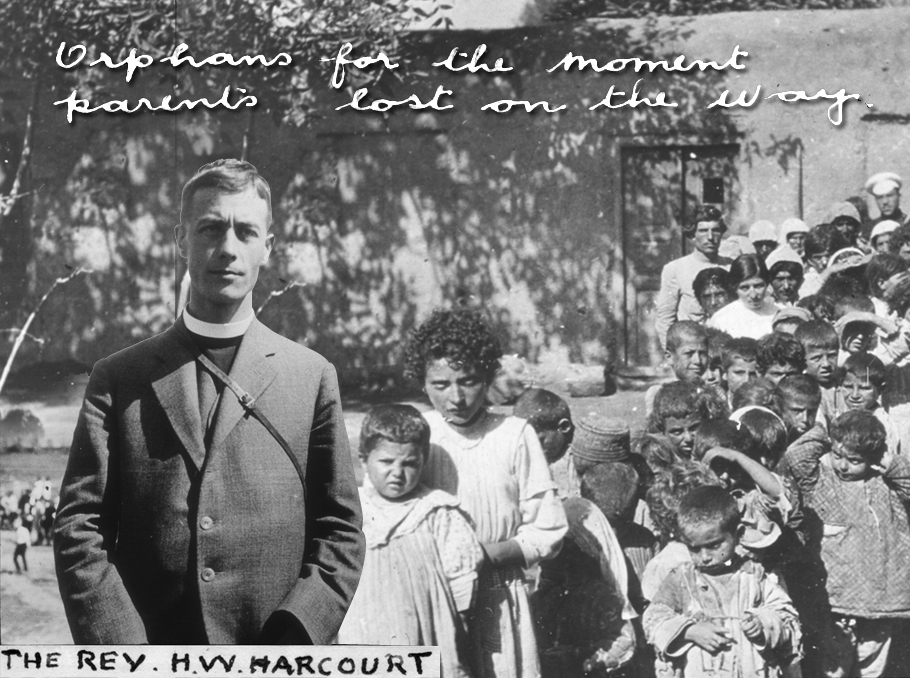
Varos Avedis Shahbazian was born on March 2, 1910 in Khagizvan, Kars, Armenia, when it was Russian territory, to Avedis Garabed Shahbazian and Goulizar Hagop, née Gregorian, both Armenian. His application indicates that his father Avedis Garabed died in World War I. Varos’s mother died when he was a baby. Varos’s granddaughter Lucine Shahbazian clarifies that both parents were killed by the Ottoman government, perhaps in 1917. When he was around 7, Varos Avedis was “put up for sale in a market square, given a new identity and ‘adopted’ into a Turkish family, probably to be a servant.” He ran away about three years later, when he was about 10 years of age. At that time, in 1920, the Reverend Hubert W. Harcourt, who was connected to the British Relief Mission in Armenia, was traveling in Armenia to work as a relief agent for the Lord Mayor’s Fund and as director of an orphanage. While sitting in a railway carriage in Yerevan, Harcourt discovered Varos Avedis hiding under a seat. A “rather wild child,” he at one point tried to flee, not wanting anyone else “to take charge of him.” A chase on the train ensued, but Harcourt succeeded in dispatching Varos Avedis to England to stay with his sister Elise Harcourt and their mother, while continuing his work in Armenia, and later adopted the boy. Varos Avedis arrived in England at the age of 12 on July 13, 1922. In their report of November 1, 1937, London Metropolitan Police specifically refer to Varos Avedis as a “refugee.” He was one of the children rescued by the Save the Children Fund. Reverend Harcourt died of cancer in his 40s.[1]
Varos Avedis Shahbazian was educated in London at the Vicarage School (July 1922-2924), the Taplow Grammar School for one term (1924-1925), and at the Porchester House School (1925). In an interview pertaining to Shabazian’s first schooling in London, the Reverend Edmund Henry Warren Leachman, Vicar of Stoke Goldington, remembered Varos Avedis as a “very quiet and reliable scholar.”
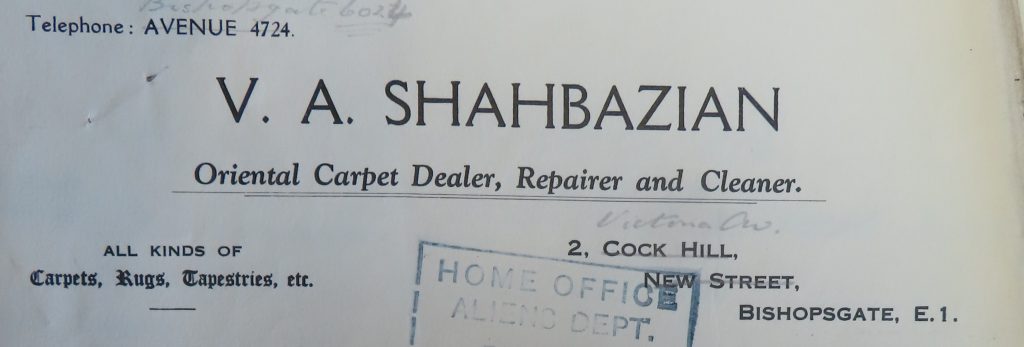
From 1926 to 1930, Varos Avedis apprenticed in the carpet dealership of Yakoubian Bros. at 2 New Street.[2] In 1930, Varos Avedis opened his own business at 2 and 3 Cock Hill, Bishopsgate, subsequently moving to 2 Victoria Avenue, Bishopsgate, and trading under the name V. A. Shahbazian. He occupied two floors comprising five rooms at a rental of £50 per annum, inclusive, and employed six British subjects. He also maintained a warehouse at Cutler Street. His business letterhead describes the company as “Planners, Repairers and Cleaners of all Hand and Machine Made Carpets and Rugs, Dealers in British and Oriental Carpets.” The Home Office discovered that in trade circles, Varos Avedis enjoyed the reputation of being “an honest and hardworking man.”
The Home Office noted that Varos Avedis had not prepared proper accounts of his business finances. Nevertheless, the records he provided painted a clear picture of his business success. Officials’ inspection of his weekly books showed that during the previous three years his turnover has been approximately £800 per annum, with drawings of £3 to £4 per week. He valued his stock at about £120 and had a bank credit balance of £42 in his bank’s business account, plus another £99 in a personal savings account. Creditors collectively owed him an amount that exceeded his business liabilities by about £50. During the three income tax years extending from 1934-1937, inclusive, his earnings were £130, £130 and £135, per annum respectively. Varos Avedis appeared to be debt free.
On January 16, 1937, Varos Avedis married Dorothy Woodroffe, a British native. There was some discussion between the couple and the Home Office regarding how her marriage to the Armenian immigrant would affect her civil status. In 1938, the Aliens Registration Office at Bow Street informed her that she would not lose her British nationality so long as she resided anywhere in the British Dominions. However, later that year, the Home Office indicated that she had lost her British nationality upon marriage. Varos Avedis’s own citizenship status was complicated. His natal territory became part of the Armenian Republic in 1918 and in 1920 was absorbed into the U.S.S.R. Shahbazian possessed an Armenian passport, which had been issued to him at the Armenian Legation in Constantinople in June of 1922. Ultimately, the Home Office instructed Varos Avedis to apply with a civil status of “no nationality” so as not to cause his bride to lose her British nationality.
Varos Avedis moved eight times between 1926 and 1936. His last address was at 20 Dewsbury Road, Dollis Hill, London, where from November 1937 he resided with his bride’s parents Dorothy, who paid £1 a week for household expenses. At the time of Varos Avedis’s final application for naturalization, the couple had one child, Varos Philip Shahbazian, who was born in London on August 3, 1937, married Christiane in 1966, and died in 2023. Varos Avedis and Dorothy later welcomed three additional sons: Souren Martin, Ara (later known as John Ara), and Dikran.[3] His will of 1982 shows that he bequeathed his share in the Shahbazian Carpet Company Partnership equally to his sons Dikran and John Ara. It also reveals that Varos Avedis was a collector of Armenian manuscripts and coins, as well as stamps. By 1982, Varos Avedis had a share of a freehold property at 12/13 Holywell Lane in London, which he bequeathed to his sons Dikran and John Ara.
Varos Avedis’s referees were mostly single women of means, an indication of the importance of the social work carried out by affluent British Christian women on behalf of Armenian refugees. All had known him for at least a decade. They included Edith Tucker, a spinster of independent means, who had met him through the referee Mrs. Charlotte M. Harcourt, with whom she shared an interest in social work; Mrs. Harcourt herself, widow of Reverend Harcourt, with whom Varos Avedis had lived as a child; and Miss Eleanor Melland, a woman of “independent means.” Other referees were Edward Carlisle, the honorary secretary to the Bishop of Gibraltar, who Varos Avedis met through Reverend Harcourt and who had taken a “keen interest” in the applicant’s welfare.
Varos Avedis had registered as alien in England. By the time he was naturalized, he had lived in the country for 14 years. Since his arrival in 1922, his only trip abroad had been a six weeks’ holiday visit to France in the summer of 1926. His last application was filed in 1936. Subfile 2 was destroyed. His naturalization application was originally closed until 2039 and declassified at my request on February 15, 2023.
Varos Avedis Shahbazian died in Harrow Middlesex on September 17, 1994. His will, made out in 1982, was probated on February 17, 1995.
[1] Lucine Shahbazian, “Reverent Hubert Harcourt who adopted orphan Varos,” The Guardian (April 21, 2016) (for quotes) and “Guest blogger,” https://caia.org.uk/guest-blogger-lucine-shahbazian/ (accessed March 11, 2026); George, Merchants to Magnates, 77 (as told by carpeteer Flora Abadjian). George refers to him as “Barous Shahbazian.”
[2] Elsewhere in his naturalization application, the Home Office indicates that Varos Avedis was apprenticed to and subsequently worked for Yakoubian Bros until March of 1931, and opened his business that month.
[3] “Varos Shahbazian 1937-2023,” Armenian Voice, Newsletter for the London-Armenian Community 76 (Winter 2023), 12.