
HO 144/15515 and HO 334/129/1768
Albert Ben Nathan (a.k.a. Albert Ben Natan and Albert Ben Nathan Tcherassi) was born in the Peri Pasha (Piripaşa) neighborhood of Constantinople, on December 21, 1872 to Joshua and Naomi Ben Nathan, née Tcherassi, both Ottoman subjects, and both deceased by 1932.[1] He attended Jewish school at Peri Pasha until the age of 12. After leaving school, he obtained employment at a general store. In 1902, he immigrated to England, where he joined his older brother Morris (a.k.a. Moses), who was in business as a dealer in Oriental laces and fancy goods at 226 Christchurch Road, Bournemouth.[2] Albert also traveled to remote villages selling artifacts door to door. In that manner, he was able to save money for a trip back to his home town, with the purpose of finding a wife. In May of 1904, he traveled to Constantinople, having already made an arrangement with one family to court their daughter. However, he ended up taking a fancy to another Sephardi Jew, Victoria Cazes, and they married in July of 1904 before heading to England. As per local Jewish custom, Victoria’s mother retained the marriage certificate.[3]
Back in Bournemouth, Albert continued to assist his brother Morris in his firm until 1908, when he started on his own account at 114 Commercial Road, with a six-room apartment above. Albert and Victoria had three children, all born in Bournemouth: Joshua (a.k.a. Jules, June 9, 1905); Victor (January 24, 1907), and Naomi (April 20, 1909). Victoria assisted in the shop occasionally. After a few weeks, they were able to afford to hire a “country girl” from Limington, some 28 kilometers east of Bournemouth, to assist with childcare.
Albert carried on with his shop until the outbreak of World War I. In August of 1914, probably a few days after Britain declared war on Germany, Albert instructed his solicitor to prepare a naturalization application for him, but was subsequently informed that “it could not be dealt with.”[4] The Aliens Restriction Act, passed on August 5, 1914, designated England’s coastal areas “prohibited areas,” seeking to prevent spying and signal passing to German naval forces. The Ben-Nathan family were given 24 hours to leave. The family decided to go to London, where Albert had two paternal uncles, Behor and Joseph, living in the Shepherds Bush neighborhood. In an interview conducted in 1993, Jules Ben-Nathan recalled how “distracted” his parents were after receiving their evacuation notice. In October of 1914, His father packed up all his shop goods in sacks and dispatched them to London by rail, but was forced to leave behind valuable fittings on the store premises. His mother arranged for the quick disposal of the household furniture. The business and domestic effects realized a scant £12. Because of their quick departure, they did not have the opportunity to pay the quarter’s shop rent of £30. They were later arraigned in court. Eventually, the landlord agreed to accept the shop fittings as rent and the case was settled out of court. Albert also had to answer for a debt from December 1914 to The Bournemouth & Poole Electricity Supply Company and another one from Messrs A. Plesser & Co., both of which he eventually settled.
In London, Albert worked as a peddler, selling his stock bit by bit, and barely eking out a living. In November of 1915, he was exempted from internment. The following year, he rented at a nominal monthly cost a small shop with a dilapidated flat above, at 33 Goodge Street, W., off Tottenham Court Road, and commenced business as an antique dealer. Both he and his wife were registered as enemy aliens with police, he at the Bow Street Aliens Office as Albert Ben Nathan, alias Tcherassi. The three children attended a local Jewish institution called the Westminster Jewish preschool.
Since many Sephardi Jews in London were selling Oriental rugs and carpets, Albert decided to attend the auctions and watch what customers were buying. He gradually learned the Persian carpet business and started to fill his shop with rugs, a little bric-a-brac, and one or two pieces of furniture. For many months, he made a fair living. One day, one of his customers, a Madame “Meschini,” told Albert about a shop rental near her own shop, at 70 Great Portland Street, a neighborhood frequented by affluent people. After consulting with friends, Albert decided to lease this shop and in January 1919, the family moved from Goodge Street to Upper Addison Gardens, West Kensington. By the 1920s, the family was affluent enough to enjoy holiday visits to France (two weeks in 1924, three weeks in 1925, and 10 days in 1930). Albert rented his Great Portland Street shop until 1929, when a downturn in the trade forced him to dispose of his lease. He then conducted commerce from his private residence until he took over the premises at 11 Hill’s Place, W., Oxford Circus, London.
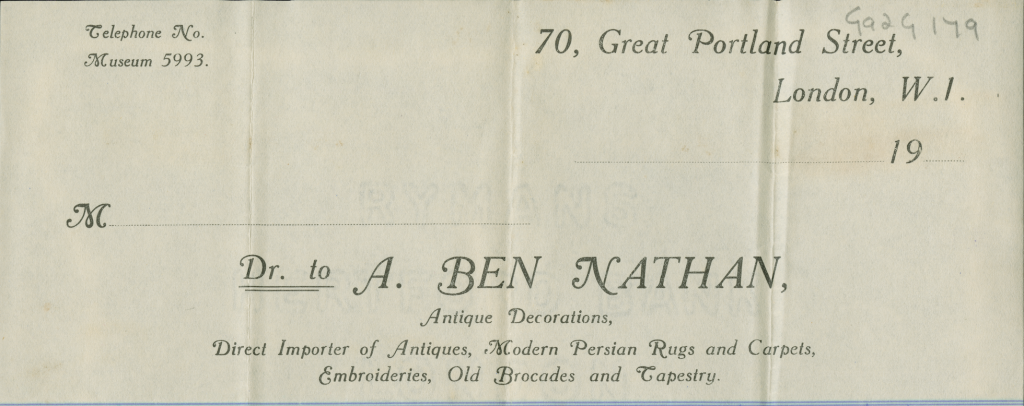
The nature of Albert’s business grew more specialized over time. His earliest surviving letterhead headlines “Antique Decorations, Direct Importer of Antiques, Modern Persian Rugs and Carpets, Embroideries, Old Brocades and Tapestry.”
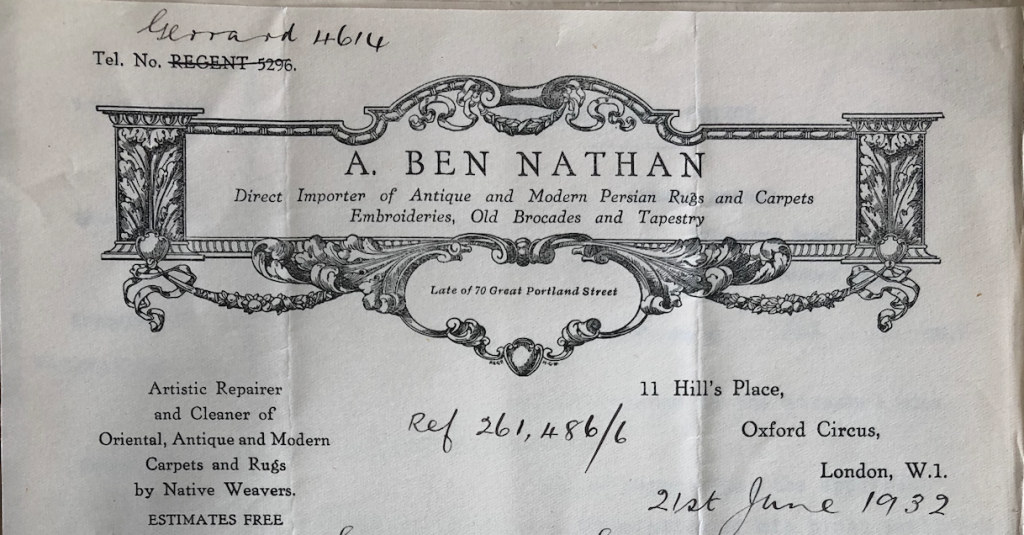
A later letterhead, included in his naturalization application of 1932, identifies his business as formerly of 70 Great Portland Street and the new address as 11 Hill’s Place. It describes him as “Artistic Repairer and Cleaner of Oriental, Antique and Modern Carpets and Rugs by Native Weavers.” The dictation and handwriting tests Albert took are written on an invoice business letterhead that identify him as “Successor to N. E. Manasse.” The document is headlined “Antique Decorations, Collector and Importer of Antique and Modern Persian Rugs and Carpets Embroideries, Old Brocades and Tapestry, Expert restorer of Oriental Carpets and Needlework.”
While the family still lived at Goodge Street, Albert’s son Jules spent time in the shop, observing and learning about the trade. When he left school in 1921, he immediately went to work for his father at his shop at 70 Great Portland Street. That year, a trade slump in the whole of Europe depreciated Albert’s stock by 50 percent. Jules tended to the shop, waiting sometimes for weeks without a single customer. At the end of the year, when he was just 17, Jules decided to seek a clerical position. When the firm he worked for closed down, he became a traveling salesman of musical instruments and tennis rackets. Early in 1926, Jules returned to work at his father’s shop. But business was still slow, so Jules used his musical talents to play violin for passengers on luxury ships, where he worked for several months. The following year, he returned intermittently to the family business. He and Albert would drive a rental into the countryside and fill up the car with Persian rugs, both handmade and reproductions. They visited antique and furniture shops in Chester, Scotland, Leeds, Birmingham, Harrogate, Bath, Ramsgate, and Margate and succeeded in paying their way. At a shop in Bath, they purchased an Aubusson carpet for twenty pounds, knowing they could sell it at auction at a triple profit.
By the time Albert applied for naturalization in 1932, Jules still resided at home and was assisting in the business. Although Albert’s command of English was fairly good, according to the Home Office, it was Jules who prepared his father’s memorial document and balance sheets for the naturalization case. Albert’s dictation test suggests why he might have needed assistance. It shows several spelling errors , e.g. “sinema” (cinema) “ar” (are), “ol” (all); “thre” (three), “apil” (appeal); and “emershens” (emotions). Jules’s sister Naomi also lived at home and was employed as a shop assistant. By this time, the middle child, Victor, had already left for America. Albert’s older brother Morris (Moise) had become a rabbi and lived at 7 Montefiore College, in Ramsgate, Hereson, Kent. Morris was naturalized in early 1932.
Albert’s balance sheets provide a snapshot of his financial state just after the start of the Great Depression. For the year 1930, he had £2,976 turnover, £1,021 gross profit, and £208 net profit. In the following year, the figures were £2,854, £862, and £216, respectively. In the year 1932, his stock was valued around £1,000. The Home Office deemed his business solvent and noted a credit balance of £50 in his Barclay’s Bank account. Albert did “regular business” there and was regarded as a “satisfactory customer.” In December 1932, he and his wife Victoria purchased the freehold house in which they resided for £1,268. She had obtained a loan of £300 from the aforementioned bank, who held the deeds of the property, and the loan had been reduced to £260.
For his 1932 naturalization application, Albert obtained a letter from the Senior Minister of Congregation Saar Hasamayim (שַׁעַר הַשָּׁמַיִם), David Bueno de Mesquita, attesting that he (Albert) was “a member of the Community of Spanish and Portuguese Jews, a community which was opposed to Governments which were at war with His Majesty King George V in 1918,” demonstrating that even after the expiration of the Order in Council in 1931, such attestations were required. Albert’s referees included a registered medical practitioner, a surgeon and member of the Royal College of Surgeons of England, an antique dealer, the managing director of a decorating firm, and a traveling salesman, whose children attended school with Albert’s and Victoria’s children. Albert’s stated motivation for applying for naturalization was that he intended to reside permanently in England, his children were British born, and he had no interests outside England. Nevertheless, just two years earlier, in July of 1930, Albert had obtained in London a Turkish passport, perhaps to leave open the possibility of direct buying trips.
Albert’s life story was captured in a videotaped interview by his son Edward Ben-Nathan, recorded in London in 1993. Before his retirement, Edward worked in computers. He was also an “avid reader of history and politics” and delivered talks on History at the School of Economic Science in London and at the Limmud festival in Birmingham, England.[5]
Albert Ben-Nathan’s final application was filed in February of 1932 and he was naturalized on July 11, 1932, after three decades living in England. Subfiles 1-5 of his application were destroyed. The file was originally closed until 2033 and declassified at my request on June 5, 2019.
[1] The Home Office noted that he was commonly known as Tcherassi until 1915, although in his 1932 naturalization application he indicates that he was trading under the name Albert Ben Nathan since 1908. The Ben-Nathan family commonly hyphenates their last name.
[2] He traded as M. Tcherassi (from Constantinople), and advertised as a Turkish and Egyptian House, Egyptian Bazaar and Oriental Exhibition. “Advertisement of Mr. Tcherassi,” The Bournemouth Daily Echo (January 8, 1902), 4.
[3] When Albert applied for citizenship in 1932, he indicated that his marriage certificate had been destroyed.
[4] Great Britain declared war on Germany on August 4, 1914 and on the Ottoman Empire on November 5, 1914.
[5] https://events.limmud.org/limmud-festival-2022/programme/presenters/B/ (accessed April 12, 2026).