
HO 144/19041 and HO 334/134/4012
Abraham Tossounian was born on December 31, 1891 in Constantinople to Avedis and Ipeksima Tossounian, both of whom were living in Constantinople at the time of his final application in 1932. He was educated at the Apostolic College in Konia and the Ottoman University of Constantinople, where he studied law during most of the Great War. He was unmarried and had a brother in America who was a U.S. citizen.
Tossounian first visited the U.K. in 1919, and remained there for a time to study English. He then relocated to New York for several months. In late 1920, he returned to Turkey via the United Kingdom, this time on business. In April of 1923, Tossounian moved to the U.K., where he launched his business. He visited France for a few months in late 1929 through early 1930. His case is an illustration of the lingering enemy alien status of Ottomans who immigrated to the U.K. after the war. He was registered with police as an Ottoman (Armenian) at the Central Register of Aliens, but in 1919 was fined for failing to notify authorities of his address while visiting the U.K. and failing to report leaving the hotel where he was staying.
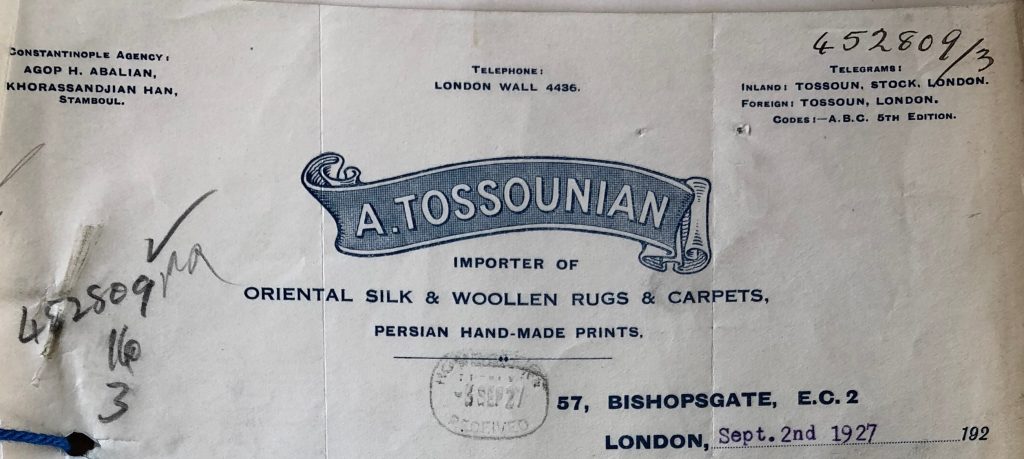
Tossounian described himself variously as a carpet importer, an importer of oriental rugs and carpets, and (on his letterhead) as an “importer of Oriental Silk & Woollen Rugs & Carpets, Persian Hand-Made Prints.” By 1928, he had a shop in London in partnership with Agop H. Abalian, a Turkish national who, at sixty percent of the profit, undertook “the buying and shipping of goods from the Constantinople branch of the concern,” and also paid short visits to London from time to time.
As part of his application, Tossounian submitted his balance sheets for the years 1929-1931, inclusive. These showed substantial net profits, particularly considering the Great Depression. The gross profits for those years were above £1,345, £1,690, £1730, respectively, while the net profits were above £845, £709, and £711. In 1933, the firm’s profit exceeded £852.
Tossounian’s application may have been delayed in part due to a claim at Lloyd’s, an insurance market in London, for the sum of over £13,231. The claim involved a bale of carpets lost during transit from Constantinople to London in 1930. Tossounian’s partner Abalian took out a claim against the Messageries Maritimes Shipping Company in the Constantinople Courts. The shipping company denied ever shipping the carpets and Lloyd’s consequently refused to pay the claim. The delay in obtaining a judgment was caused largely by a fire in the courts at Constantinople that resulted in the burning of many documents, thus necessitating that some of the evidence in the case be reheard. The issue was resolved with Abalian acknowledging full personal responsibility in the matter.
Another possible reason for the delay was that Tossounian’s name was dragged into an extensive case of commercial fraud involving the sale and purchase of Oriental carpets and other textiles. In 1932, William Morris Cohen and Jacob (a.k.a. Jack) Wolf Hyman, two Glasgow-based businessmen, began to peddle panels of antique Persian embroidery sewn on velvet, claiming that they had receiving the items from Tossounian on contingency. The two instructed a client in Glasgow to make out his cheque to Tossounian, which Hyman then cashed, forging Tossounian’s signature.[1]
Tossounian’s referees included a foreign bank manager, an insurance clerk who assessed Tossounian’s personal effects in a professional capacity, and a druggist. Tossounian’s business evidently placed him in a respectable position, reflecting social purchase of the Oriental carpet trade. In a letter he wrote to the Home Office in 1927, he asserted that he enjoyed “good connections with many English Firms, as well as with many English People of distinct society who will give good testimonials about me if required.”
Tossounian was in possession of a traveling permit from the Home Office issued in 1929, a passport issued by the representative of the Armenian Republic in Constantinople in 1922, and a Turkish passport issued in that city in 1923. The Home Office instructed him to identify his nationality as “Ottoman (Armenian).”
Once Tossounian’s application proved successful, he notified the Home Office of his desire to have his name on his certificate listed as “Tossoun” instead of “Tossounian.” He explained that “the ending of ‘IAN’ is not an essential part of the name. It is an ending to surnames adopted in general by the Armenians living in Turkey in order to differentiate themselves from the Turks. Besides, it makes the name longer than usual and more difficult to spell.” The Home Office refused to accommodate his request, citing procedural regulations.
Tossounian commenced his penultimate application in December of 1927. He was naturalized in 1934. Subfiles 1-2 and 5 were destroyed. This file was originally closed until 2035 and declassified at my request in 2013.
[1] National Records of Scotland, Edinburgh, AD21-11, trial of William Morris Cohen, Jacob Wolf Hyman, et als.