
HO 144/11658 and HO 334/102/13155
Joseph Souhami was born in Izmir on 12/18/1881 to Eli Souhami and Rachel Souhami (née Souhami). His parents were identified on his naturalization memorial as “Ottomans (Spanish Jews)” and were deceased by the time of his final naturalization application in 1925. Souhami was educated at the Scotch Missionary School in Izmir and married Luna (Louise) Souhami, née Chaul, an “Ottoman (Spanish Jewess)” in Izmir on December 7, 1903. Souhami possessed no birth certificate and his marriage certificate was destroyed years before by fire. The couple’s children were Rachel (born June 14, 1905 at 3 Soho Street, W.C.) and Alia (born January 5, 1907 at Bamborough Gardens, Shepherds Bush). Joseph Souhami had two sisters, Vida Arditti, (Izmir) and Joya Fernandez (Lyons, France), both Ottoman.[1] Strangely, he made no mention of his brother Benjamin Souhami, an Ottoman subject and French protégé, who deceased by 1929, nor of sister-in-law Caden Souhami, née Algranati, an Ottoman subject and “Ottoman (Spanish Jewess),” still living in Izmir by 1929. Raphael Souhami, the son of Benjamin and Caden, immigrated to England just before World War I and in 1919 became the business partner of Joseph’s wife Louise (Luna) at the Vigo Art Galleries.
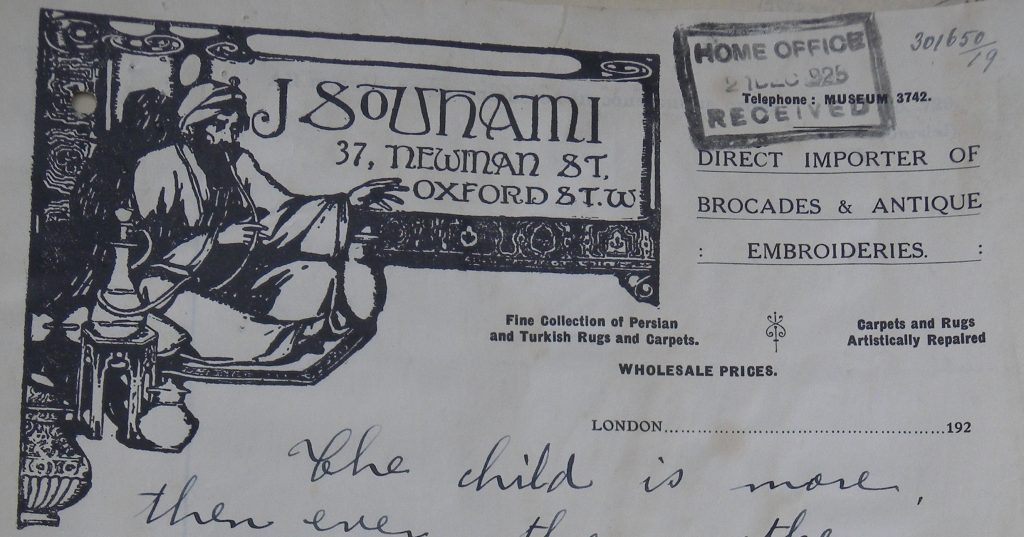
At the time of his final application, Joseph Souhami was a dealer in antiques, embroideries and carpets at 37 Newman Street, W., operating a business in his own name. His letterhead reads: “Direct Importer of Brocades & Antique Embroideries.” He enjoyed a “high reputation as a judge and expert in the Oriental antique and carpet worlds.” His career entailed frequent travel. He first arrived in the United Kingdom in May 1901 and carried on business at Dunbarton Road, Glasgow for 5 months. He then left for Paris. In May 1903, he visited England to attend the Earl’s Court Exhibition. In November of that year, he returned to France. He took up permanent residence in England in August 1904 (or around September 8, 1904) and opened a business at 35 Newman Street, W. After three years, he moved it to 47 Newman Street. In 1912, he relocated it to 37 Newman Street, Oxford Street West. He had a similar business at 96 Gloucester Road, W. and 96 Victoria Street, S.W., both of which he had disposed to compatriots by the time of his final naturalization application in 1925. He undertook business trips to Paris, Italy, and Egypt from (March 17, 1920 to June 22, 1920). He undertook a business trip to the continent, leaving from Dover (December 17, 1923 to March 3, 1924). The Home Office also notes that Souhami made frequent short business trips to Paris. He returned from a business trip to the U.S. on March 12, 1926, commissioned by customers in the U.S. to purchase certain tapestries. He explained that in order to obtain some of these items he had to proceed to France and Spain and requested of the Home Office to expedite his naturalization. Until then, he was traveling with a Home Office travel permit and was unable to obtain any national passport. He acted in an advisory role from November 1919-May 1924 to his wife, a partner in the Vigo Art Galleries, which was a similar business to his own. After her retirement from this business, he had nothing to do with the firm.
As an enemy alien, Souhami was required to account for his movements in minute detail. He moved domiciles fairly often and had more than one residence. From 1918 to 1924, he lived in an apartment at 86 Marine Parade, Brighton, in a large house converted into flats. While in Brighton, he traveled to and from London daily for business with the exception of January 26, 1919-May 21, 1919, when he was staying at Dean’s Hotel in London. For his business trip to Paris, Italy, and Egypt (1923-1924), he gave up his Brighton residence. His wife left the United Kingdom on December 20, 1923, perhaps to join him. Although he failed to report relinquishing his Brighton residence, as he should have as an alien, he was not prosecuted for the offence. During none of visits to Nice, Paris, or elsewhere in Europe did he relinquish his domicile in the United Kingdom. From 1923 to 1924, for example, he also had a temporary address at Hanover Gate Mansions in Regents Park, N.W. He owned a villa at 265 Promenade des Anglais in Nice, where his wife and daughter were vacationing at the time he filled out his naturalization questionnaire in 1925. The Home Office noted that Souhami spent two months in Nice each winter since 1916, including January and February of 1924. On April 22, 1924, Souhami moved from 86 Marine Parade. At the time of his application in 1925, he had a temporary address in Royal Palace Hotel, High Street, Kensington and a permanent address in Acton, Middlesex, where in September of 1924 he had purchased a house at 46 Creswick Road for £1,080. From March to July 1924, he had lived at Berners Hotel in Oxford Street and from July to November, 1924 in Lyncroft, Thames Street, Staines, Middlesex.
Joseph Souhami’s financial condition was “sound,” a decided understatement. In 1923, his business had a turnover of £22,084, with a gross profit of £6,520 and a net profit of £1,869. His tax return of 1924 showed a turnover of £14,043 and a gross profit £1644, with net losses amounting to £2,966, due to the depreciation of the value of stock by 50 percent. He also had outstanding loans to the value of £9,017. The turnover for 1925 promised to exceed £26,000 and, as there had been no further depreciation in the value of the stock, there was every reason to believe that he would have a successful trading year. His accountant called Souhami “a very substantial man.”
Joseph Souhami identified on his 1925 application as a “Spanish Jew (Ottoman)” and presented to the Home Office a declaration from London’s Spanish and Portuguese synagogue that he was a member of the “congregation of Spanish and Portuguese Jews.” Both he and his wife were still registered with the police as aliens. He was exempt from internment on March 18, 1918 and did no public or military service. Luna Souhami held a French passport issued in London on November 15, 1920. During the war, he was treated by the French government as a protégé français. He held a French passport issued in London on December 15, 1924. He had previously travelled with a Home Office Travel Permit. He had no other national passport and applied for naturalization so that he could have a national status while traveling. He also applied because he intended to permanently reside in the United Kingdom, having lived there for 24 years, and having two British-born children “educated to English ideals.” Moreover, he wanted his 17-year-old son to enter Cambridge University and that his progress “should in no way be hindered owing to his parent’s alien nationality.” Souhami added that his interests were centered in England and he had acquired great admiration for British customs and constitution. He passed the literacy test, and spoke, read, and wrote English “adequately.” Home Office officials did not remark upon the several spelling errors in his dictation test.
Souhami’s agents were Mole & Ward. His referees were Lionel Judah Levi, a carpet merchant and art dealer of 34 Ambleside Avenue, Streatham, with a business at 163 Victoria Street, S.W., who had known him for 24 years in both business and on intimate social terms. Another referee was Victor Jourado, an art dealer and manager of 76 Morsehead Mansions, Maida Vale, with a business at 16 Mount Street, W., who had known him for 15 to 20 years. They had met when Jourado was a boy and Souhami visited Jourado’s parents. Other referees were Oscar Callow, a friend and art dealer of Halliford House, Halliford-on-Thames, Middlesex, with a business at 10 Mount Street, W., who had known Souhami for 20 years, and Horace Brown Hacker of Woodbury, Linfield, Surrey, a collar manufacturer with a business at 56A Murray Street, Shepherds Walk, N1, London, who had known Souhami for 7 years through business and had let his flat to Souhami for over 5 years, also becoming his friend and visiting him at his Staines residence.
Upon his final application in 1925, Souhami was 44 years of age. He was naturalized on March 19, 1926. His naturalization packet was enormous. It originally totaled 19 subfiles. Officials in 1925 referred to it as a “bulky file.” It is unclear when Souhami first applied for British citizenship nor why naturalization eluded him for so many years, for subfiles 1-8 were deliberately destroyed, probably by archivists in the 1950s, and the other subfiles are unaccounted for.
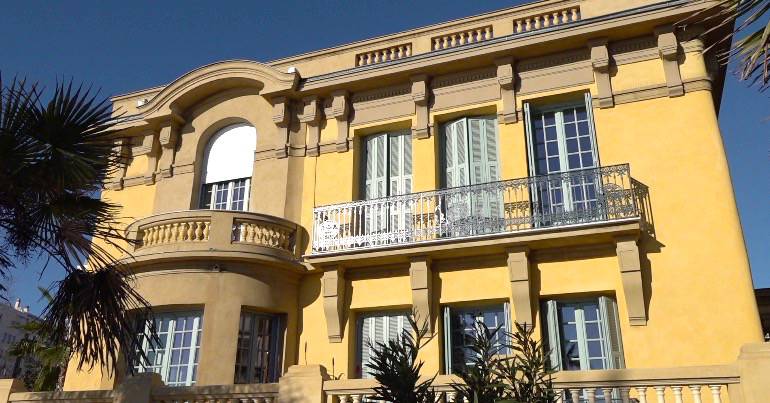
An internet search reveals that Joseph Souhami’s Nice property was a seaside mansion called “La Luna” (named after his wife), situated along the French Riviera on the Mediterranean. It was embellished with the type of luxuries Souhami sold in his business, including ancient and modern art objects, tapestries, and Aubusson carpets, all of which were sold at auction in May 1929 by M. J. Souhami. Joseph Souhami died on September 26, 1926.[2] Starting in the late twentieth century, the mansion was abandoned for close to 20 years by its owners, degraded, occupied by squatters, and vandalized. Because of its historic status, it was inscribed in 2010 as a patrimony to safeguard and in March 2012, the municipality initiated an expropriation procedure.
The file was originally classified until 2031 and appears after the file of Joseph Souhami’s nephew, Raphael Souhami.
[1] Her name reads “Veida,” probably an error.
[2] https://bibliotheque-numerique.inha.fr/collection/item/68882-objets-d-art-et-d-ameublement-anciens-et-modernes-garnissant-la-villa-la-luna-collection-j-souhami-vente-des-30-et-31-mai-1929?offset=30580; “Re Joseph Souhami, Deceased,” The London Gazette (3/12/1929), 1783; Commissaires-priseurs de Nice, Vente après décès de Monsieur J. Souhami et par autorité de Justice, des Objets d’Art et d’Ameublement (1929).