
HO 144/7330 and HO 334/106/15223
Menahem Eskenazi was born in Constantinople on March 15, 1882 to Ottoman nationals Maurice Eskenazi and Louise Eskenazi, née Nigri. He attended the Alliance Israélite Française school in Constantinople. He immigrated to England in May 1905 at the invitation of his brother-in-law, Isaac Gerson, a carpet dealer, with whom he went to work. At the time of his last naturalization application in 1926, he had one brother in Constantinople and one sister married to a naturalized British subject and living in London. By that same year, his father was deceased and his mother was living in Constantinople. Menahem was originally registered with police as an Ottoman national and obtained a Turkish certificate of nationality from the Turkish Consulate in London on March 13, 1924. On his memorial, Menahem identified as an Ottoman “of Spanish origin” and as a member of the Spanish and Portuguese Jewish community.
He married Bella Benardout, a woman variably identified as “Ottoman” and “Ottoman-Spanish,” on August 9, 1909 at the Bevis Marks Spanish and Portuguese synagogue in London. He spent the year after his marriage as an itinerant lace merchant. The couple had four British-born children: Lizzie (June 9, 1911); Gentille (January 20, 1913); Lillie (July 16, 1914), and Maurice (September 20, 1919). Bella was registered as an alien with Metropolitan Police.
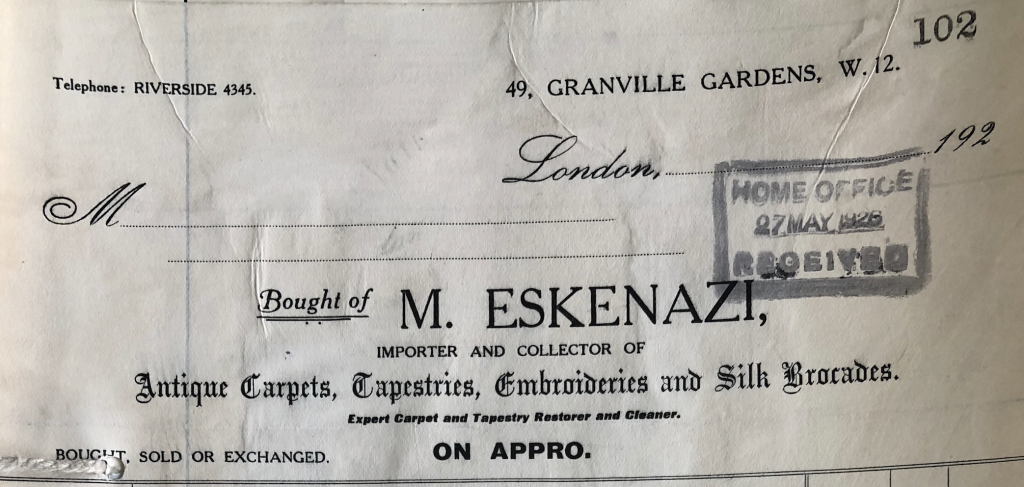
In around 1910, Menahem entered into a partnership with two relatives, Solomon Afia and Aron Cohen Benardout, as carpet dealers on New Street, Bishopsgate. On account of bad business, they dissolved the partnership on July 12, 1913. Then, Menahem, together with Benardout and Jack Moreno Pontremoli, launched another carpet concern at 6 The Arcade, South Kensington Station, under the style of the Anglo-Persian Carpet Company. In August 1919, owing to differences of opinion, the partnership was dissolved. For the next four months, Menahem worked on his own and then joined Robert Arditti in another carpet business at 61a Brompton Road, in west London. On account of bad business, the two separated on December 5, 1921. Thereafter, Menahem carried on business under his own name as a carpet repairer and dealer from his home address. Menahem would visit various auction sales where he purchased damaged carpets, repaired them, and then sold them to other carpet dealers. He also engaged in repair work for Eastern Carpets Ltd., 4 Newton Street in west London, and for Messrs. Benardout and Carmona at 121a Victoria Street, in southwest London. While Menahem was primarily a carpet repairer, he also dealt in carpets, tapestries, and other textiles. At the time of his last naturalization application, he was running a business at his private residence in Shepherd’s Bush Green and earning £200 per annum. His business letterhead survives because he took his writing test on it. This test shows a good command of the English language and fine penmanship, but also spelling and pronunciation errors. The Home Office characterized his English as “adequate.”
Menahem was exempted from internment on November 9, 1916. But from May 9-June 15, 1918, he was engaged at Tytherington Stone Quarries, where Austrian Prisoners of War were housed and put to work.[1] He registered as an alien with the Metropolitan Police both during the war and in accordance with the Aliens’ Order of 1920. In August of 1924, Menahem’s wife purchased the leasehold property where the family lived. The couple sublet a portion of this house at £29.6 per week.
Menahem’s referees included a technical expert in the Export Credits Guarantee Department of the Department of Overseas Trade and a fellow tenant, an antique dealer and valuer of antiques and works of art, a manager of a bootmaker’s shop, a grocer, a dairyman, a dealer in domestic stores, a physician surgeon, and a retired manufacturer of advertising novelties. Three of these men described Eskenazi as quiet, industrious, and honest. The Home Office investigators noted that Menahem’s previous business partners were Ottomans who had been exempt from internment during the war. They also observed that Menahem only associated with his relatives and people of his own nationality and usually spent his days in the company of relatives at various sales. In the evening, he stayed home, repairing carpets.
Menahem’s earliest surviving application dates to 1925, but he likely applied several times before then. At the Home Office’s prompting, he took advantage of a loophole extended to Ottoman Jews by securing a letter from Reverend David Bueno de Mesquita stating that he was a member of a Spanish and Portuguese Jewish community that had been opposed to the Ottoman government during the war. In this way, Menahem was able to avert the regulation that Ottoman nationals could only apply for naturalization starting in 1931. Regardless, it still took two years and his agent’s aggressive prodding of the Home Office bureaucracy to get his application processed, by which time (1927) he had resided in England for 22 years and was 49 years of age. Subfiles 1-4, 6, and 8 were destroyed. This naturalization file was originally closed until 2028 and declassified on June 22, 2009.
[1] Mike Osborne, Defending Gloucestershire and Bristol (Barnsley, U.K.: Fonthill Media, 2024), chapter 5.