
PRO 267301 and HO 144/7223
Moise Abraham Alfandary was born in Constantinople on December 7, 1871, to Behor Alfandary and Rebecca Alfandary, née Salmona, both Ottoman subjects of Spanish descent. He was educated in the Alliance Israelite Universelle school in Constantinople. He was fluent in English and could also speak Turkish, Yiddish, and French. He arrived in England on July 1, 1891 and had lived there for nearly 34 year when he submitted his final application for naturalization in 1927. During his residence in England, he had been abroad for a total of 18 months before and after World War I, visiting Germany, France (for his health), Constantinople (one month in August 1893 and two months in December-January 1901-1902), Europe, the U.S. (June-December 1904), and the Netherlands. During the war, he was exempted from internment.
He married Jennie Rosenbloom on September 17, 1894 at the Bevis Marks Synagogue in London. Their children, all British-born, were Alma (June 13, 1895), Reina Sol (October 28, 1896, who was married and living in Italy as Mrs. Cittone), Albert (September 14, 1898, who married in Berlin and served in the British Army from 1915-1919), David (November 2, 1901), Elizabeth (January 23, 1906), Edward Benjamin William (July 27, 1907), and May Mariam (June 24, 1911). In 1925, he served as trustee for the erection of a new synagogue for the Spanish and Portuguese Jews Congregation (Holland Park Synagogue). His leadership position helps to explain why the Holland Park synagogue was nicknamed “el kahal de los tapeteros.”
At the time of his final application, Alfandary had resided at 3 Old Oak Road, Acton, the County of Middlesex, London since July 1914. He was a carpet merchant, in partnership with his brother Salomon since 1924, when they were granted exemption from the Aliens Restriction Amendment Act and permitted to trade as “Alfandary Frères.” Their business was located at 7 New Street, Bishopsgate. The Home Office characterized their business as a “very lucrative trade” and that Afoumado’s case needed “strong support” given his “bold enterprise in business and extravagant spendings.” In 1923, the last year he did business on his own account, his turnover was £105,795.16.6, with a gross profit of £6,737.11.6 and a net profit of £2,611.1.6. The next year, his first in partnership, saw a turnover of £147,721.15.2, with a gross profit of £16,763.13.4. His net profit share was £5,645.0.2. In 1925, the business had an even greater turnover, with over £175,447 and a net gain for Afoumado of over £3,518. By 1927, he had received a further £3,409 in recovered debts and his business had the previous year become a private Limited Company, with a nominal capital of £40,000, to be divided into 40,000 shares of £1 each. The directors of the company were Alfandary and his brother Salamon, who resided at 468 Uxbridge Road, Jacques Alfandary, an Ottoman subject living in Constantinople, Raphael Alfandary, a Spanish subject residing in Berlin. Alfandary and his London brother were the shareholders, with £2,500 shares each. The first line of Alfandary’s business letterhead clearly disclosed his nationality of origin: “M. Alfandary (Ottoman)” and “S. Alfandary (Ottoman),” “direct importers of Oriental carpets and rugs.” The letterhead identifies the company as based in Constantinople, although in over thirty years of residence in England, he took only two trips to the Ottoman capital.
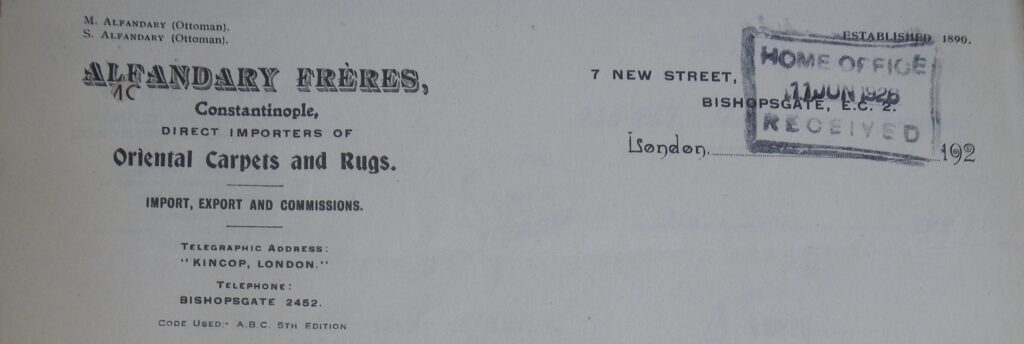
business letterhead of Alfandary Frères
1926, Alfandary reported to the Home Office that his business had “not been very good for some time,” but no better than “any other firm in that line of business,” a puzzling statement given the documented bounty years of 1923-1925. Alfandary’s financial status at his bank, Midland Bank (171 Bishopsgate), was so strong that he was permitted to overdraw his account up to £10,000. In 1925, he and his brother Salomon opened a second account with the National and Provincial Bank (15 Bishopsgate), where he was also allowed an overdraft of £10,000. Additionally, Alfandary had a private account in the Westminster Bank, with a balance of over £214. In 1926, he had stock worth £23,000. His carpets, furniture, and household goods in his private house were worth about £1,000. His annual house and business rent was £100 and £300, respectively, aside from rates and taxes. Despite the high turnover and net profits rate, most of his money was invested in the business and his ready cash savings amounted to under £800, possibly owing to, the police report speculated, his large family and the “lavish scale” on which they lived.
Alfandary identified in his naturalization application as an “Ottoman Subject (Spanish Jew) … descendant of a Spanish or Portuguese family which was driven from the Spanish Peninsula at the time of the Inquisition and which settled in the Levant.” In 1925, he submitted a letter from David Bueno de Mesquita, Senior Minister of London’s Spanish and Portuguese Jews Congregation, attesting to his membership in the congregation. His only passport was an Turkish one, issued by the Turkish consul in London in 1925.
Alfandary first applied for naturalization around September 1910 (a Police Report from 1926, however, gives the date as September 1914). Alfandary was 54 years of age when he submitted his final naturalization application in late 1925. His reasons for applying were his long residence in the United Kingdom (“the greater part of his life”), the British-born status of his wife and children, his business in England, his “great admiration for the British Constitution and Customs,” and the benefit of his children to have the same nationality as their father. His referees included Thomas Herbert Neville, an Oriental merchant of “Remenham” Salt Hill, Slough Buckinghamshire and 1 Wood Street Square, London, who knew Alfandary in business for over thirty years, Harold Miller, an Oriental carpet broker of “Lone Field” Danbury, Chelmsford, Essex and 11 New Street, Bishopsgate, who knew Alfandary in business for a quarter of a century, Reuben Cohen, a tailor and Alfandary’s neighbor for over eleven years, who periodically met with him at the Holland Park synagogue, and Charles Gray, a builder and Alfandary’s landlord since July 1914 and next door neighbor (the latter two men resided at different addresses on Old Oak Road in Acton). The additional referees, chosen because they did not know Alfandary through business (as per the Home Office’s specification), were J. Mackay Huey, a doctor who met Alfandary seven years previously through a mutual friend and whom he subsequently met at Jewish social functions, and his brother-in-law Hyman Rosenbloom, known as Henry Rose, a retired tailor, who first met Alfandary when he was courting his sister thirty-three year previously. Alfandary’s naturalization certificate, issued in 1927, identifies him as a widower; the Metropolitan Police report indicates that his wife had died around April 1926.
This file was originally closed until 2028 and was declassified at my request on February 20, 2009.