
HO 405/1200 and HO 334/330/7932
Serab Agopian was born in Smyrna on March 14, 1887 to Kevork and Elizabeth Agopian, née Thaglian (also spelled in this file as Taglian), both of whom were deceased by 1949. His parents are variously described as “Turkish-Armenian” and “Armenian-Ottoman.” He was educated in Smyrna until the age of 16, when he entered his father’s textile business. In 1907, he opened up his own textile business in that city, where he traded for the next five years.
In 1912, he immigrated to the United Kingdom and was employed as a buyer by T. Alinack, Shipper, in Manchester. From 1917 to 1937, he maintained his own business as a textile agent and shipper under the name S. Agopian, exporting mainly to his brother in Smyrna. On June 3, 1916, he married Madeleine (spelled “Madeline” in the naturalization certificate) at the Armenian Church in Manchester. They lived apart since 1938 due to “domestic difference.” The couple was childless.
Agopian identified himself variously as a “Turkish Armenian” and as an “Armenian.” On his 1946 naturalization application, in somewhat broken English, he wrote that since his birth, he had acquired “in a qualified sense an English” nationality by virtue of “permanent abandonment of my Domicile of Origin (Armenian-Ottoman) and acquisition of Domicile of choice (English) by 34 years residence in England.” While in England, Agopian had traveled to France in 1921, 1928 (on holiday), and 1946 (to visit his ill mother), and to Egypt and Cyprus in 1931 (for business).
The Turkish occupation of Smyrna was a turning point in Agopian’s life. in 1922, he lost all his money when that city was sacked by the Turks. Since that time, he had never been successful in business, although he managed to support himself and his wife until 1937, at which point he discontinued trading on his own account. A period of intermittent unemployment followed. From 1940-1945, he was successively employed as a warehouseman, metal miller, and a semi-skilled assembler for a manufacturing company, but from 1945-1948 he was unemployed. During his financial crisis period, Agopian was fully supported by his friend and naturalization referee, James Crook, at whose Manchester home he had lived since November 1938. Cook assured the Home Office that he would financially support Agopian as long as his friend was unemployed. In February 1948, Agopian began to assist Crook’s son John F. Crook run a textile merchanting business in Manchester. Agopian worked on a commission basis and aspired to obtain an allocation from the Board of Trade, which would enable him to re-open his textile agency.
Agopian’s financial status seems to have played a major role in the Home Office’s reluctance to naturalize him. In 1947, they assessed him as “more or less destitute,” his sole assets being £4 in the Post Office Savings Bank and £200 worth of canaries, which he bred as a hobby. Despite Agopian’s job as a manager in the aforementioned textile business and his intention to start up a textile export business in the near future with borrowed capital, the Home Office in 1947 resolved to postpone consideration of Agopian’s application for two years. Home Office officials could find no evidence that Agopian had planned to repay his friends. His only known payment plan dated to 1933, when he had made an arrangement with his creditors to pay off some of his debts of £560.
Agopian’s personal life may have also given the Home Office pause. They noted that his wife resided at the Women’s Hostel in Manchester, that he did not provide for her maintenance, that she had brought him to court on the grounds of “willful neglect,” and that had applied for a separation order. The case was dismissed and Madeleine was by 1949 financially independent. In an application for a travel document filled out in March of that year, she expressed her desire to settle in Palestine, but had not yet departed.
Serab Agopian applied multiple times for naturalization, beginning in at least 1940, when he was 53 years of age. That year, his case progressed so far that the Home Office allowed Agopian’s agent to proceed with the publication of a notice in newspapers regarding Agopian’s imminent naturalization. Yet, this immigrant had to wait nearly a decade before his application was successful. He was finally naturalized in late 1949, after 37 years in England.
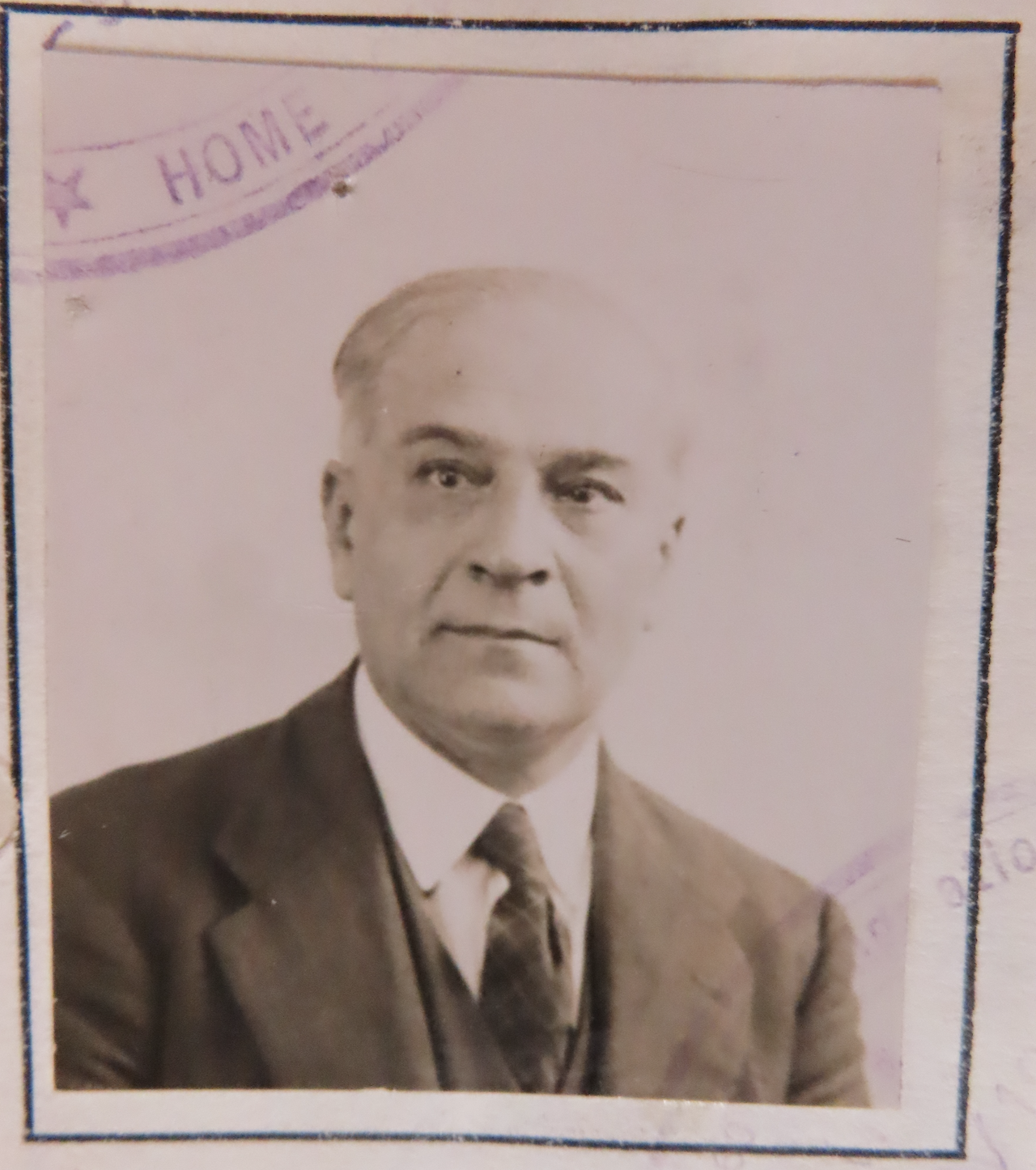
Agopian’s naturalization file was originally classified until 2050 and was opened at my request in 2025.